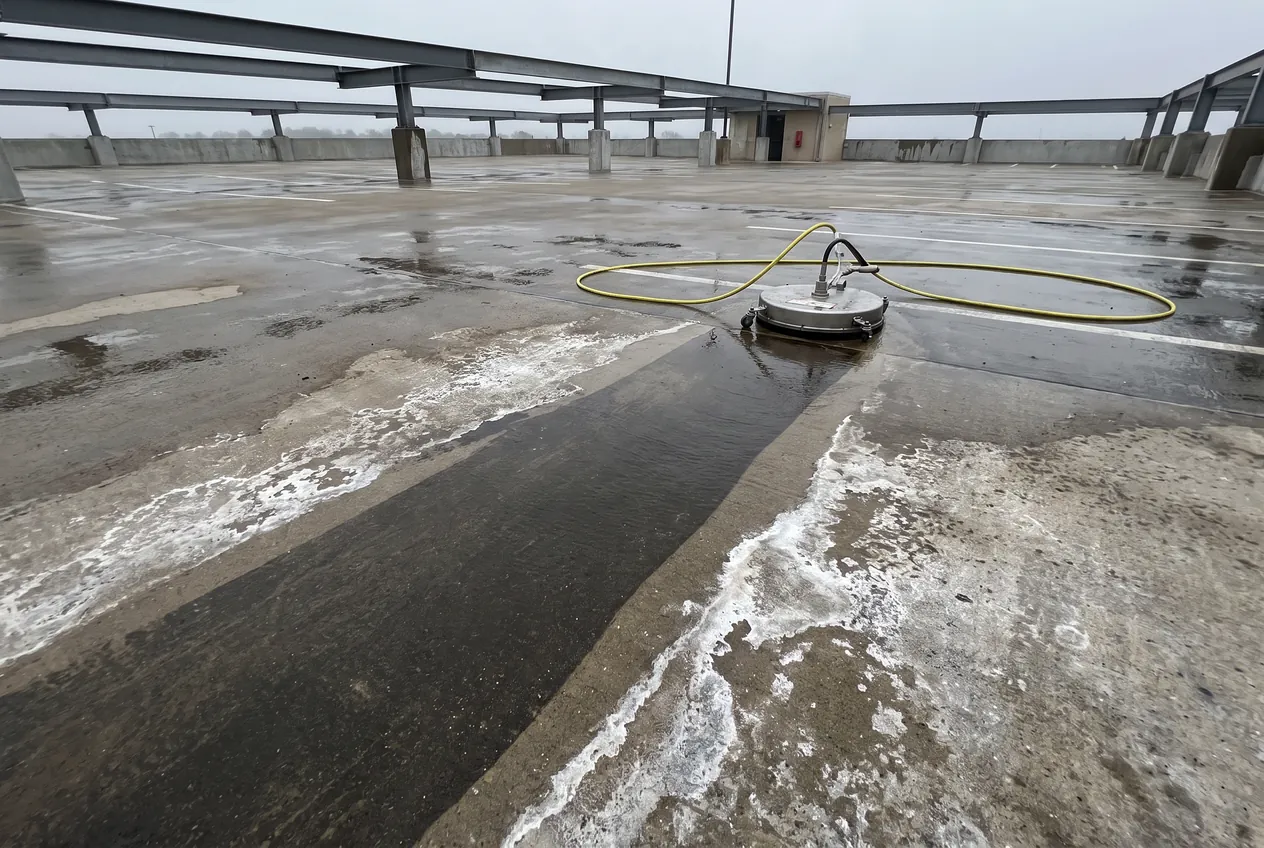
This page covers business and commercial property, not houses. On flat concrete, most crews run a rotary surface cleaner, a round deck with spinning nozzles that cleans an even path without the striping a single wand leaves behind. Hot water does much of the heavy lifting on grease near restaurant doors, oil drips in parking stalls and flattened gum by the entrance. Walls are handled differently. Soft washing applies a detergent at low pressure, lets it dwell, then rinses, because high pressure can etch masonry, strip paint, damage wood and push water behind siding or into window seals.
Before work starts, the crew covers exterior outlets, light fixtures and card readers, then sets out wet-surface signs. Large properties are usually washed in sections so at least one entrance stays open, and most jobs happen early in the morning, overnight or on a weekend. Runoff deserves a direct question. Water carrying detergent, oil and grime generally is not allowed to flow into storm drains under local stormwater rules, so ask how the crew blocks drains, recovers water or discharges it to an approved point. Ask for proof of liability insurance too, since the work happens next to glass, vehicles and the public.
The most common mistake is using one pressure setting for everything. A wand that cleans a dumpster pad well can gouge softer concrete, scar brick mortar or lift paint off a steel door. Another is booking a wash before the salt season is fully over, then watching a late March storm coat the sidewalk again. Some buildings also skip the drive lanes and stairwells of a parking ramp, where oil and sand collect in corners. Finally, sealing concrete right after washing, before it has dried fully, can trap moisture and leave a cloudy finish.
Pressure washing after a Minneapolis winter
In Minneapolis, outdoor washing follows the thermometer. Water sprayed near freezing turns into ice on sidewalks and ramps, so most providers pause exterior work through the cold months and pick it back up in spring. That first spring wash carries the heaviest load: months of road salt, sand and slush residue left as a white crust on concrete, curbs, stair treads and the lower few feet of building walls. Buildings tied into the skyway system still have street entrances and parking ramps that collect the same grime. Warehouse and light industrial sites across Hennepin and Ramsey counties add loading docks, where salt mixes with tire marks and spilled product.
Most spring requests arrive once overnight lows stay above freezing, and calendars fill quickly after that. Retail fronts in Uptown and the North Loop tend to want early morning washes before shops open. Office parks in Bloomington, Eden Prairie and Plymouth often book a full sidewalk, entrance and parking area clean on a weekend. Downtown Minneapolis and St. Paul buildings frequently add a second wash in late summer or fall, so walkways go into winter clean and the next round of salt has less to stick to.
What changes the cost of commercial pressure washing
- Surface area and type
- A long run of open sidewalk goes quickly with a surface cleaner. Walls, columns, stairs and curbs take more time, and soft washing painted or stucco surfaces is slower than flat concrete.
- Buildup and stains
- Concrete under a full winter of salt, or oil-soaked parking stalls, needs hot water, pretreatment and extra passes. A property washed every season usually needs less work per visit.
- Water handling
- Sites where runoff must be blocked, recovered with a vacuum system or sent to an approved discharge point need more equipment and setup than a site with an easy, permitted drain path.
- Timing and access
- Overnight or weekend work, washing in sections around open entrances, and limits on where the truck can park or where hoses can run all affect how the job is scheduled and quoted.
Sample pressure washing schedule
| Task | Frequency |
|---|---|
| Entrances and main sidewalks | Monthly in season is common |
| Dumpster and trash enclosure pads | Monthly or more in warm months |
| Loading docks | Every 1 to 3 months in season |
| Parking ramp decks and stairwells | Once or twice a year |
| Building exterior soft wash | Every 1 to 2 years, as needed |
| Spring salt and sand removal | Once each spring, after the thaw |
Read this as a baseline, not a commitment. After walking your office and hearing how people actually use it, your provider will revise it.
Typical scope of work
- Rotary surface cleaning of sidewalks and plazas
- Hot water degreasing of oil and gum
- Soft washing for painted walls and siding
- Salt and sand residue removal
- Loading dock and dumpster pad cleaning
- Parking ramp decks and stairwells
- Covering outlets, lights and card readers
- Wet-surface signs and sectioned work
The final task list and schedule get agreed between you and the provider during the quoting process.
Service areas
Businesses throughout the Minneapolis area send us pressure washing requests, including from Downtown Minneapolis, North Loop, Northeast Minneapolis, Uptown, St. Paul, Bloomington and beyond. See all areas.
More cleaning services in Minneapolis
- Commercial Cleaning in Minneapolis
- Office Cleaning in Minneapolis
- Janitorial Services in Minneapolis
- Medical Office Cleaning in Minneapolis
- Floor Care in Minneapolis
- Post-Construction Cleaning in Minneapolis
- Day Porter Services in Minneapolis
- Commercial Carpet Cleaning in Minneapolis
- Commercial Window Cleaning in Minneapolis
- Disinfection Services in Minneapolis