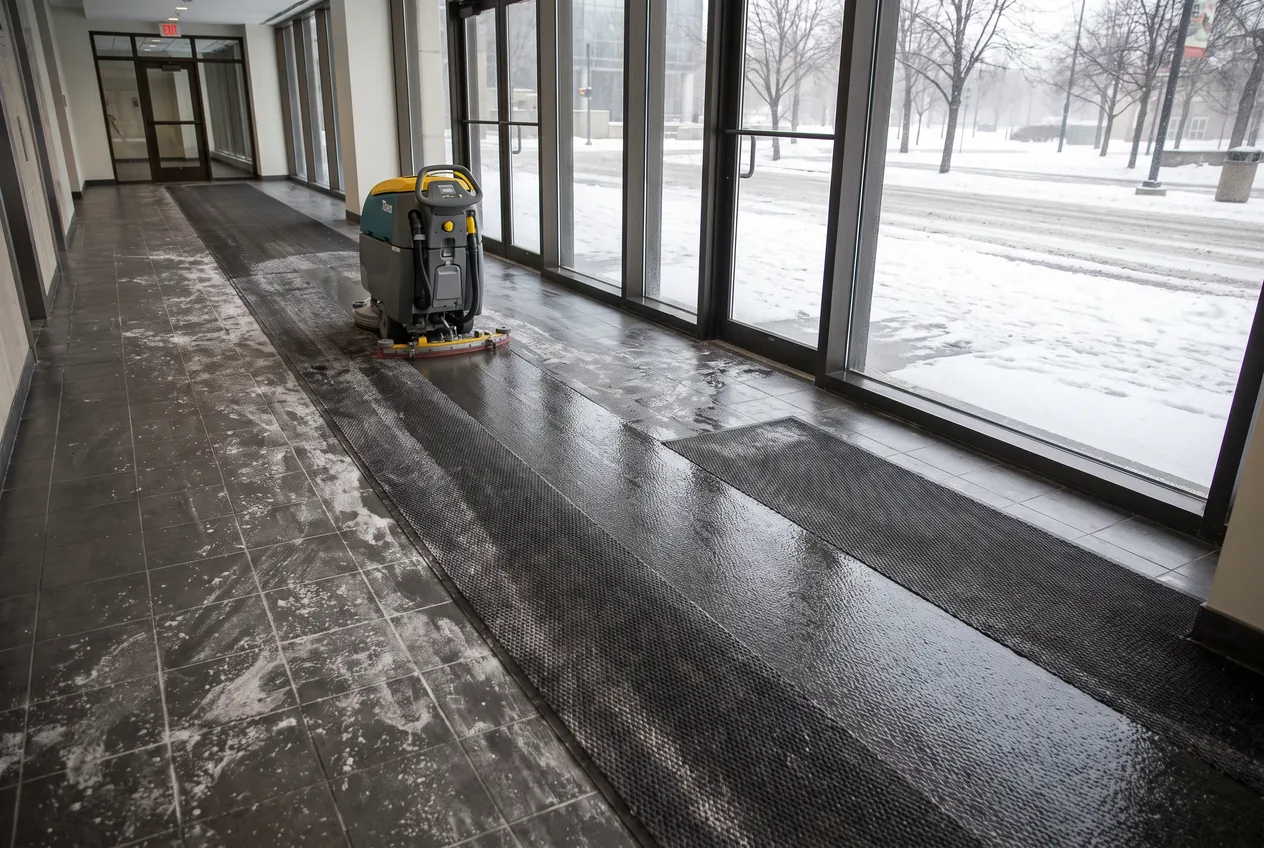
What salt and ice melt do to floors
Rock salt and the calcium and magnesium chloride ice melts spread on sidewalks and parking lots dissolve into the slush that rides in on boots. When that water dries, it leaves a white film on hard floors. The film dulls the finish and makes the surface slippery, and once foot traffic grinds it in, it wears the finish away along the main walking paths.
Carpet is damaged in a different way. Salty water wicks into the fibers near entrances and dries into white or tan rings that reappear after ordinary vacuuming. Left through a long winter, the residue stiffens the fibers and holds onto more dirt. Both problems are far easier to manage with steady daily attention than with one large cleanup after the snow melts.
Stop it at the door with matting
The easiest salt to remove is the salt that never makes it past the entrance. A matting system catches grit and moisture over several steps, and it works best when people take several strides across it before they reach the hard floor. Matting only does its job while it stays clean and fairly dry, because a soaked mat simply passes the slush along.
- Outdoor scraper mat to knock off snow and grit
- Indoor wiper mats long enough for several steps
- Mats at side doors and loading entries, not only the front
- Matting at entries from parking areas
- Daily vacuuming so mats keep absorbing
- Soaked mats swapped or extracted during storms
A daily and weekly salt removal routine
Through the salt season, entry floors need work every day on top of the regular cleaning. The routine below fits most offices and commercial lobbies, and busy buildings may repeat the entrance steps during business hours. Daily attention keeps the residue light enough to lift with a damp mop instead of letting it build into a crust that takes machines to remove.
| Task | Frequency | Why it matters |
|---|---|---|
| Dust mop or vacuum entries | Daily | Removes grit before it scratches the finish |
| Damp mop with a neutral or ice melt residue cleaner | Daily | Lifts the white film without harming the finish |
| Vacuum and spot treat carpet at entrances | Daily | Keeps salt from settling deep in the fibers |
| Auto scrub large lobbies and corridors | Weekly or after storms | Cleans and picks up the water in one pass |
| Rotate or extract entry mats | As mats saturate | A wet mat stops trapping slush |
| Extract salt rings from carpet | As rings appear | Flushes residue that vacuuming leaves behind |
| Scrub and recoat resilient floors | Once, after the thaw | Restores finish dulled over the winter |
Getting the cleaning method right
Ordinary all-purpose cleaners often leave salt residue behind or smear it into a haze. A neutral floor cleaner, or a product made specifically to remove ice melt residue, does a better job and is kinder to the finish. Follow the dilution on the label, because extra concentrate leaves a residue of its own that turns sticky and attracts more dirt.
Controlling water matters as much as choosing the product. Flooding a tile floor pushes salty water into seams and under baseboards, and over-wetting carpet drives the residue deeper and slows drying. Damp mopping with frequent changes of rinse water, picking up with a wet vacuum or auto scrubber, and rinsing carpet thoroughly during extraction all leave less salt behind.
Salt season in Minneapolis
Minneapolis winters bring road salt, sand and slush into every lobby, and the season runs long enough that a building can carry salt on its floors for months. The paths from the front doors, parking entrances and elevator lobbies take the worst of it, and that is where the finish wears thin first. Planning the winter routine in the fall costs less than repairing floors after they turn gray.
Downtown buildings on the skyway see people moving through most of the day, and their street-level entrances still take salt from everyone who comes in from outside, so those floors can need attention more than once during business hours. Suburban office parks in Bloomington, Eden Prairie and Plymouth face parking lot salt at fewer doors. Across the metro, many buildings book heavier floor care for the end of winter.
Spring recovery
Once the thaw arrives, resilient floors such as vinyl composition tile usually need a scrub and recoat to clear the last of the residue and restore the worn finish along traffic paths. Floors with heavy wear may need a full strip and refinish. Carpet near the entrances benefits from a full extraction, and the entry mats should be deep cleaned or replaced before next season.
Use the spring visit to review the winter. Note where the finish wore through, which entrances brought in the most salt and whether the mats were long enough. Adjusting matting, cleaning frequency or daytime coverage before the next snow costs less than repeating the same floor repair every spring.